
AI and Job Quality: DiPLab’s Paola Tubaro at ETUI’s Future of Work Conference
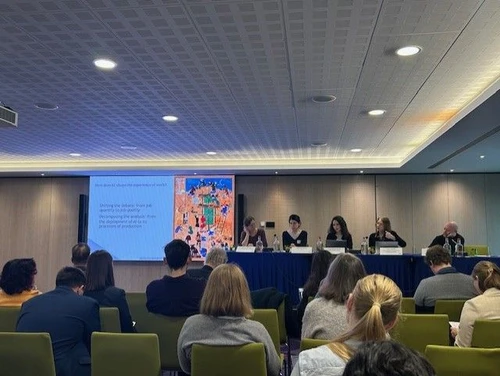
DiPLab - Thursday, February 12, 2026The European Trade Union Institute (ETUI) hosted the conference “Future of Work” in Brussels on February 10-11, 2026, bringing together researchers, policymakers, and practitioners to examine how contemporary transformations are reshaping the world of work. Among the contributions was a presentation by DiPLab’s Paola Tubaro, who offered crucial insights into the relationship between artificial intelligence and job quality.

Tubaro’s presentation centered on a forthcoming chapter titled “What is AI doing to Job Quality? Platformization, Fissured Workplaces and Dispersion,” co-authored with Antonio Casilli. This work will appear in the new edited volume Job Quality in a Turbulent Era, edited by Janine Leschke and Agnieszka Piasna and published by Edward Elgar Publishing Ltd.
The chapter’s key intervention challenges a common assumption in discussions about AI and work: that technology alone determines outcomes for workers. As Tubaro emphasized during her presentation, AI does not operate in a vacuum. Instead, its impacts on job quality emerge from the broader political economy and organizational contexts in which these technologies are introduced and deployed.
The chapter explores three interconnected phenomena transforming contemporary work:
- Platformization: The expansion of platform-based work arrangements that mediate labor through digital technologies, creating new forms of employment relationships and power dynamics.
- Fissured Workplaces: The fragmentation of traditional employment structures, where work is increasingly outsourced, subcontracted, or restructured in ways that distance workers from the organizations that benefit from their labor.
- Dispersion: The geographic and organizational scattering of work processes, enabled by digital technologies but shaped by strategic choices about how to organize production and manage labor.
The conference featured a preview of the new book on job quality, with editors Leschke and Piasna exploring how AI, digitalisation, and decarbonisation are reshaping work organization and affecting core components of job quality—not through technological inevitability, but through deliberate choices made by organizations and policymakers. Dr. Funda Ustek Spilda complemented these discussions with concrete insights on datafication and surveillance practices at companies like Sama and Amazon UK, demonstrating how these dynamics transform work on the ground. Dr. Massimo Mensi, serving as discussant, reinforced a crucial theme: governance choices matter more than the technology itself. He also challenged the common framing of training as a cost, arguing instead that it should be understood as an investment in workers and work quality.